
Small bit of whisky news this week.
On 11 September, English Whisky officially got Geographical Indication status — the same kind of legal protection Scotch has had for years. It takes effect on 1 October. Basically, it means "English Whisky" now has a proper legal definition, the same way Scotch does.
What I didn't expect is that England didn't just copy Scotland's rulebook. A few of the differences genuinely surprised me.
The grain has to be British, but oddly, the whisky doesn't have to be made start to finish at one distillery — mashing and fermentation can happen somewhere else before it goes off to be distilled. That's actually stricter than Scotch on the grain side, and looser on the "single malt" side, which hasn't gone down brilliantly with the Scotch Whisky Association.
The rules around the stills are looser than I expected too. Malt English Whisky must include distillation in a copper pot still, but the specification does not require every part of the distillation equipment to be copper.
And — this is the one I find most interesting — it doesn't have to be matured in oak. Just wooden casks. Scotch has to be oak (even the sherry and wine casks you'll have seen on a distillery tour, like at Lindores Abbey, are oak casks that previously held sherry or wine — the wood itself is still oak). English Whisky drops that requirement entirely. Oak's given as an example, not a rule. I'm curious to see what that opens up.
The bit that gets me, though: they're allowing both spellings. English Whisky and English Whiskey are both legally protected, even though the specification itself says "Whisky" is the customary one.
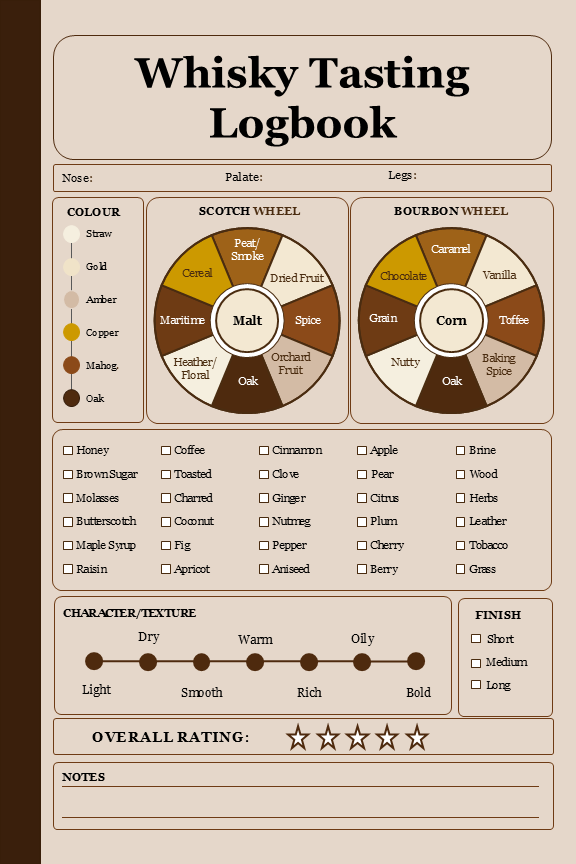
I have opinions about this, mostly because I publish separate UK and US editions of my own tasting journal for exactly this reason — whisky for the UK, whiskey for the US. An English whisky enthusiast who ended up with the US edition once spotted the E straight away and told me it was wrong. People really do notice.
So I'm not convinced allowing both spellings makes anything clearer for someone stood in front of a shelf. But I suppose it gives producers more room, especially for export.
Either way — from 1 October, English Whisky (or Whiskey, take your pick) finally has an identity of its own.