
Small confession: I ruined my first attempt at Vietnamese coffee before it even reached the machine.
To explain how I ended up with it, I need to go back a bit.
How I got here
I used to be madly in love with medium-roast Arabicas from Ethiopia and Uganda. The Ethiopian ones especially had these boozy aromas, like opening a bottle of rum, and an effervescent quality I adored.
Then my stomach objected and I had to find something much lower in acid. Black Gold from West Berkshire Roastery, an Arabica from El Salvador, was my first rescue. They call it a medium to dark roast, but to me it's a dark one. It's very smooth as a black filter coffee and it delivered on the low acid. A further search for low-acid coffee led me to Vietnamese coffee, and to a bag of Dừa Blend from Vietnamese Coffee Co. in Belfast.
Dừa (often written Dua) means coconut. When I opened the bag, that's exactly what hit me: sweet, exotic and very intense. (Their website says "warm Raffaello", and honestly, fair.)
What is culi coffee?
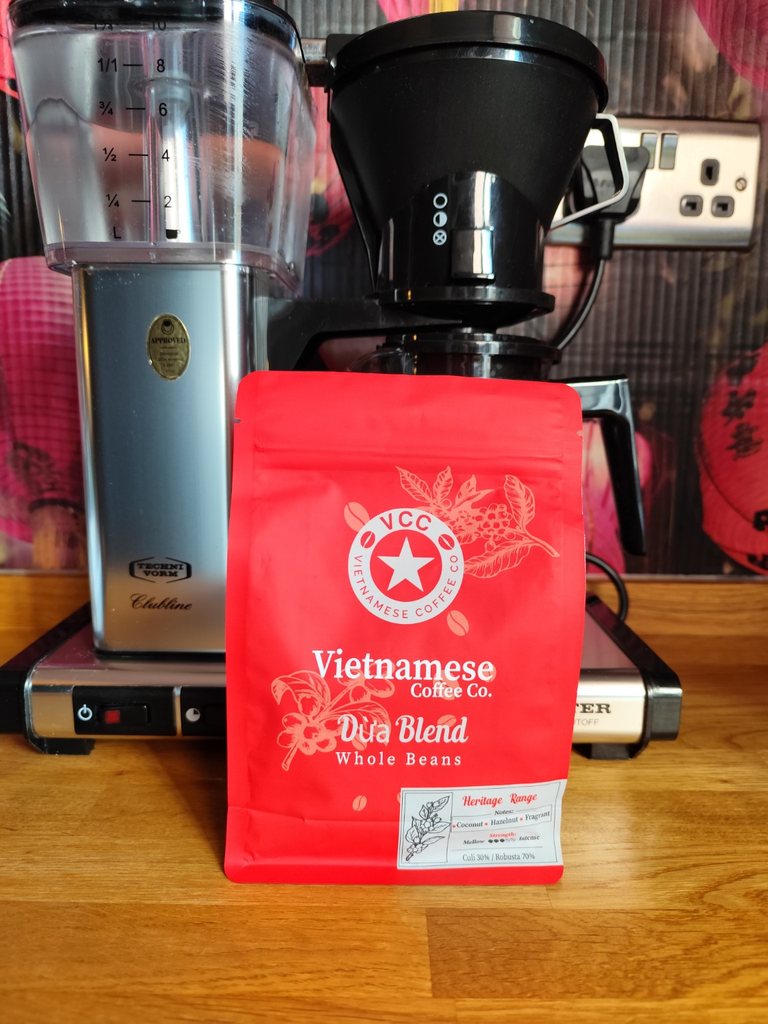
The bag says Culi 30% / Robusta 70%. Culi is Vietnamese for peaberry. Most coffee cherries hold two flat-sided beans, but sometimes only one seed develops, and it comes out small and round. In Vietnam these are sorted out and sold as cà phê culi (Vietnamese peaberry coffee), and they're mostly Robusta.
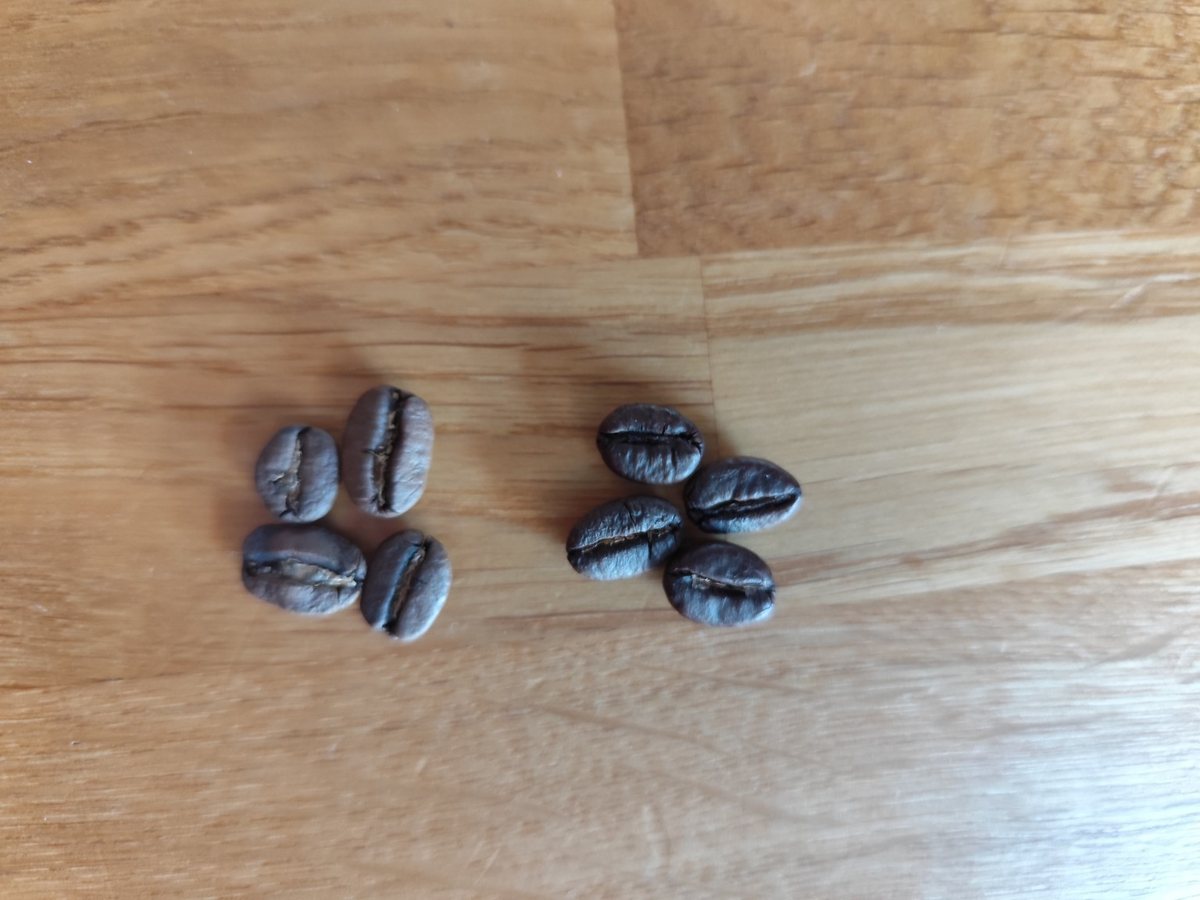
Next to the Arabica, the Vietnamese beans look smaller, rounder and darker.
How I ruined the first batch
My blade grinder gives a fairly coarse grind on Arabica in ten seconds. I did the same with these beans and got almost powder. It smelled burnt, and the coconut had vanished completely.
In hindsight it makes sense. Robusta is smaller and more brittle, and a blade grinder adds heat. For the second batch I ground for six seconds, stopping to check at four and five. The coconut survived.
In the cup
I brewed it black in my Moccamaster. The coconut is milder than in the bag and a little different, but it's definitely there. The coffee is smooth, full-bodied and not harsh. Robusta is naturally lower in perceived acidity, which is why it suits me. (It also has roughly twice the caffeine of Arabica, so I'll be careful with cup number three.)
Something about this cup reminded me of a coffee from long ago. After a while it hit me: 20 years ago, living in Germany, I used to prepare ready-ground Dallmayr Prodomo from the supermarket in a filter coffee machine and drink it black every morning. It can't be the beans, since Prodomo is Arabica, and I don't remember any coconut in it. I think it's the mouthfeel, that soft, rounded smoothness.
The coconut on my flavour wheel
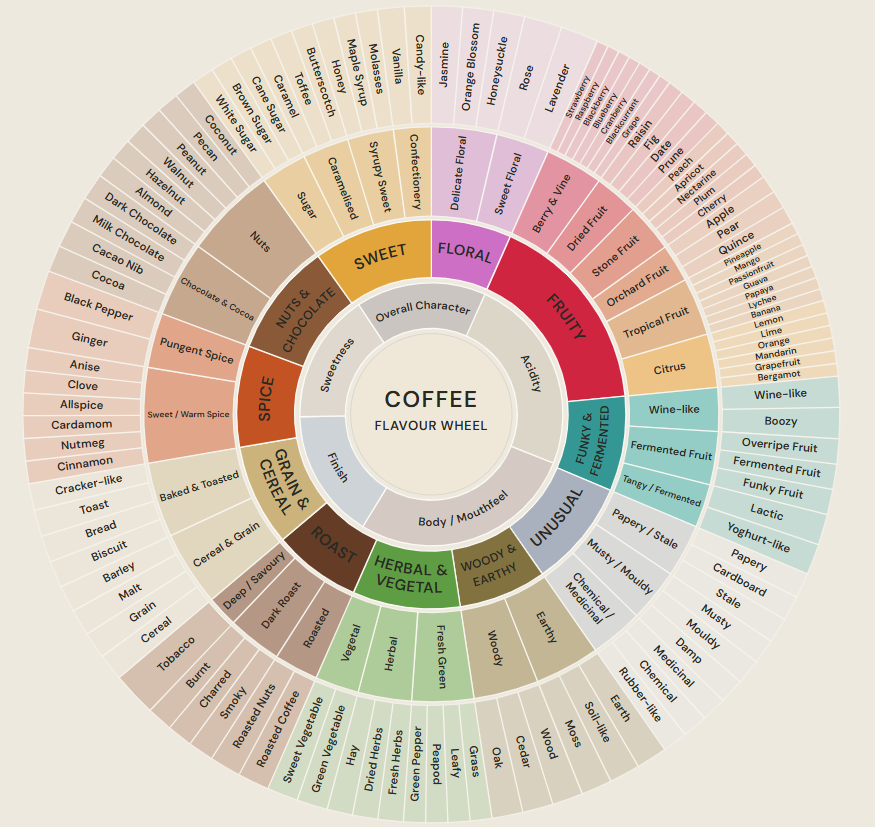
This coffee made me want to select coconut under Tropical Fruit on my interactive Coffee Flavour Wheel, and it wasn't there.
Then I realised I'd filed it under Nuts, in the Nuts & Chocolate section, next to pecan and hazelnut. That does fit the name, although botanically a coconut is a fibrous, single-seeded fruit called a drupe, and loosely speaking it can count as a fruit, a nut and a seed. It's a proper rabbit hole I don't want to sidequest into right now, so coconut stays under Nuts.
Is the coconut in Dừa Blend natural or flavoured?
I'd like to know. Coconut-like notes can develop naturally through roasting and processing, but flavoured coffee exists too, and the website just says 100% authentic Vietnamese coffee. I've emailed the roaster to ask how it's processed and roasted, and whether anything is added.
I also asked about the strength rating. My bag says 3 out of 5 beans, but the website's whole-bean bag photo says 4.
Either way, the coconut is real in my cup, and I'd happily buy it again. I'll just keep my finger off the grinder button.
Update · 21 September 2026: the roaster wrote back
Small confession, part two: I sent Vietnamese Coffee Co. a very long email with a lot of questions, and I was fully prepared for a short "thanks for your feedback" in return. Instead I got a lovely, detailed reply that went through my questions one by one. It came from Martin, who runs the business together with his brother. That's two people doing everything, and they still took the time to answer every single point. I was very impressed, and it made me even happier that I bought from them.
Here's what I learned.
Processing is a closely guarded secret
Martin explained that Vietnamese producers are notoriously secretive about their post-harvest processing and roasting, so he can't tell me whether the Dừa Blend is honey, anaerobic or washed. He was upfront that this isn't ideal from a specialty coffee point of view, and that it comes with importing directly from source. (It's also a big reason why hardly anyone else in the UK does what they do.)
What he could tell me is that the coffee is grown in the Lam Dong region of the Central Highlands and fully roasted in Vietnam. Lam Dong is known for low-acid Robusta with a heavy body and natural nutty notes, which he says pair well with the coconut aroma.
So is the coconut natural? He didn't say outright that nothing is added, so I can't tick that one off completely. The nutty notes point in a good direction, but I'll leave it there rather than claim more than I was told. What I can say is that I still get a hint of coconut walking into the kitchen hours after brewing, and that I very much enjoy drinking it. A tiny heads-up for anyone sensitive to caffeine: this kept me noticeably more alert for longer than any Arabica brew I've had.
The grinding
I was right to cut the time. Martin says Robusta is harder and denser than Arabica, so grinding it for the same length of time creates extra fine particles, and that's what gives the burnt taste. That's a correction to my "more brittle" guess above. I'd still blame my blade grinder a little.
Mystery solved: the strength rating
The website mismatch was from a wrong graphic being uploaded for the whole bean listing when they updated their photos. The 3 out of 5 on my bag is correct, which makes it Medium-High intensity, and the website graphics are being fixed.
No roast date, and why
The traditional range is fully roasted in Vietnam and then makes the long sea journey to Belfast, so there are no roast or batch dates on the bags. Traditional Vietnamese roasts are built for stability, and Martin says Robusta actually benefits from a long rest to settle its harshness. That may well be why my cup was so smooth and easy on the stomach. If you prefer locally roasted, their Modern Blend range is made from green beans imported from Vietnam and roasted in the UK. Next I'm looking forward to trying their Nêm Blend, which is hand roasted in small batches. The description of black cherry and molasses with a slightly sour undertone sounds delicious to me. I've always had a thing for sour cherries.
Thank you, Martin.